

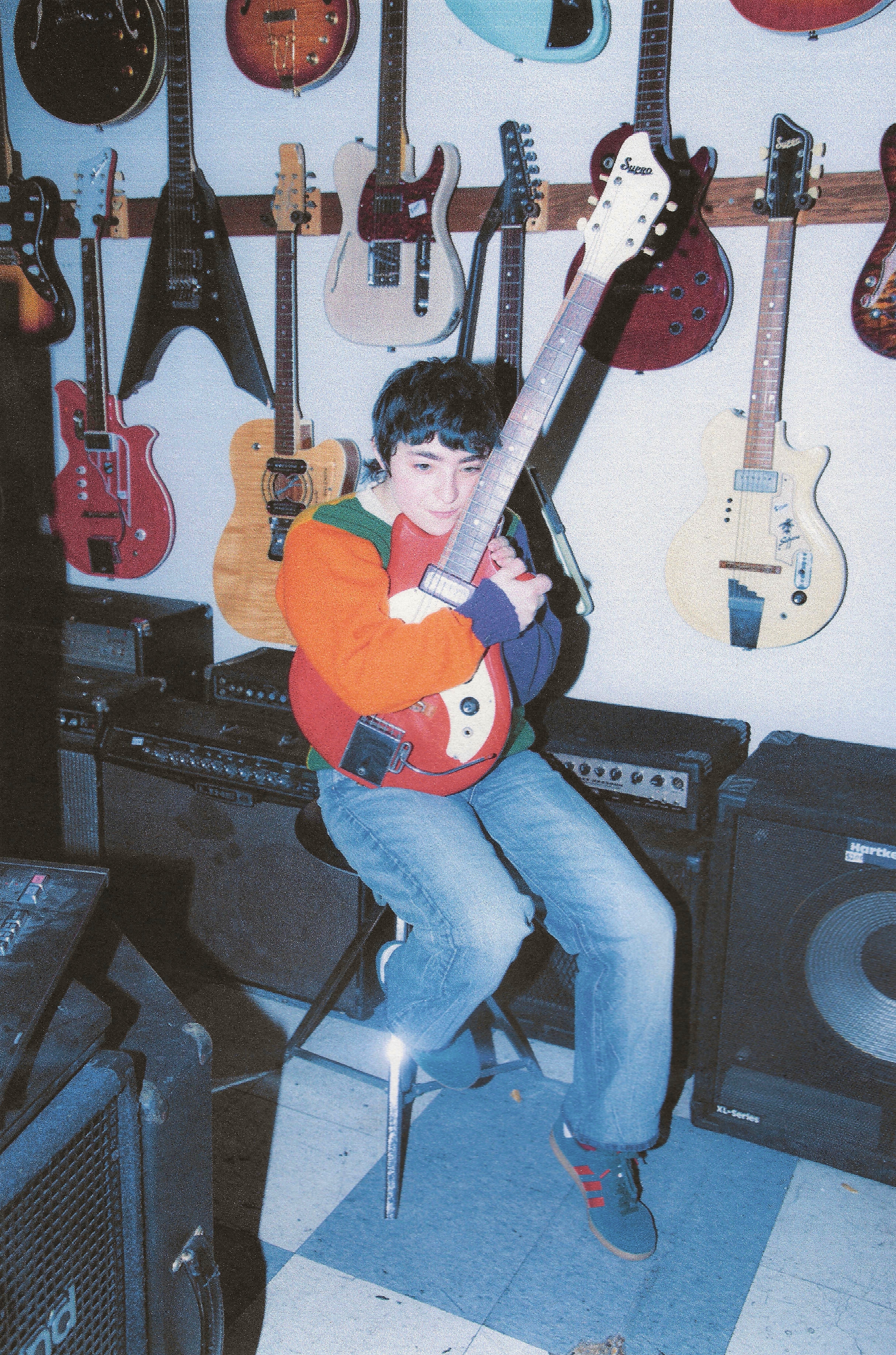
The weight of the world right now can feel immeasurable, and creating “successfully” under its mass can tend to feel like a magic trick. When leaning into complete escapism, you risk feeling out of touch, yet taking yourself too seriously pulls you headfirst not only into total perfectionism paralysis, but into the line of fire as irony epidemics and fleeting senses of literacy continue to ravage art at large. For Claud Mintz, among many of their collaborators, it’s that thin, wobbly line between radical sincerity and absurdism where the real art comes to life.
On their latest record, Me and the Music, Claud trades the heads-down, solo grind of perfectionism for a far more healing practice: inside jokes turned anthemic bangers, and the honest comfort of workshopping narratives with close friends.
I’ve been a big fan of Claud’s for quite some time, so getting to chat with them was truly so special for me. Don’t miss it!
25F: I wanted to start and talk a little bit about the transition between your last record, Supermodels, and this record now. Something I really liked about your approach, and I love when artists have this philosophy, is realizing that taking things overly seriously can sometimes work to their detriment and lead to a sense of paralysis. Was there a moment in creating this record that made you realize that fun and community were going to be the core aspect, or was that an idea you had before the album started?
Claud: It was definitely something I realized later. I didn’t know what to do because I was questioning every useful decision I was making, and I wasn’t in a good enough place to have the discipline to write by myself all the time. The only time I was writing or making music that I actually liked was when I was hanging out with my friends.
You know how there are certain friends in your life where you can be brutally honest about things going on that you can’t believe you’re saying out loud? I found writing with them felt like that. It was like, “Oh yeah, I can actually say the deepest, darkest thing I’ve been thinking, and then we can laugh about it and make an awesome song about it,” you know?
Yeah. Or on the flip side, you can speak about whatever’s on your mind, propose a song, and I’m sure there is the intuition and honesty where someone can also be like, “This might not work for a song, but still, thank you for telling me this.”
Exactly.
I also feel like a lot of the time, being overly serious and being sincere are really hard things to differentiate. Sincerity, especially in music, is a very powerful and positive thing, but I can also imagine it’s a fine line. How do you manage practicing sincerity in your everyday process without letting perfectionism paralyze you, keeping that border between sincerity and an overly serious situation?
I’ve always teetered on the line of being too sincere. I’ve never really struggled with being insincere to a fault. It has gotten me into situations where I was accidentally too honest and rubbed somebody the wrong way, or I cry a lot, in both good and bad ways. That’s something I’ve always wanted to keep true to my music. Even if I’m kidding, there is a level of sincerity there.
There are a few songs on the record where you don’t fully understand the song unless you know that I’m not completely sincere, but I’m also not kidding. Songs like “Gay Witchcraft” are like that. If taken extremely literally, it could be slightly eye-rolling. But it’s hard to digest both at the same time. I’ve been curious to see how people understand the record and how it hits them, whether they think it’s totally hilarious or totally heartbreaking and serious. Both are awesome to me.
I feel like you also get that feeling a bit from “She Doesn’t Love Me,” especially with the visuals. On a first listen, you just hear the track, but on a second listen with visuals, you catch the silliness alongside the heaviness. You frame the heaviness of living in America right now through the metaphor of a toxic relationship, which I’m sure many people have experienced. As you create melodies and stories, how do you balance biting cultural critique without dimming it down while also trying to make an infectious pop beat?
I was so worried people were going to misunderstand it. This is the issue with my over-sincerity. After I wrote “She Doesn’t Love Me,” I thought, “Oh god, people are going to think I’m making light of such a serious subject.” But my friends were like, “No, this is pretty on the nose.”
I’d agree with them, too!
I was really killing myself over it for a while because the label really wanted it to be the first single. I was like, “It can’t be a single! I’m not even sure it can be on the record because what if people misunderstand it?” And they reminded me, “You’re forgetting your whole thing.” And I was like, “Oh yeah, I am.”
It’s interesting reading online discourse about my music, especially with this record, because I really wanted to know how people were understanding it. The first few days, I thought people were taking it way too literally and didn’t understand it, but now I realize they totally get the whole record. I thought “She Doesn’t Love Me” was a funny way to start because it could mean a lot of things.
How does reading online discourse about yourself, positive or negative, or seeing people interpret a song differently than you intended, impact you? Does it help, or does it make the creative process more exhausting?
That’s a really good question. Honestly, I don’t read it that often, but with this album I was curious to see how it was hitting people. On Reddit pages or forums that are pretty niche and indie, where the context of a trans person is understood, it’s usually a much better discussion.
Around the time “I Owe You,” the second single, came out, a couple of TikToks hit the mainstream algorithm, and people were like, “What the fuck is this?” They just didn’t understand it. They thought I looked like an ugly 12-year-old boy and didn’t know what was going on. I thought, “Wow, that’s so interesting, and exhausting to read.” Comment after comment of people completely misunderstanding me.
When it’s that kind of criticism, I don’t care because it’s not an educated opinion. But I do like reading conversations between people who are super into music and into the artists I listen to. That’s interesting to me.
I can also imagine hearing input from queer listeners, whether it’s positive, neutral, or negative, can be daunting because it’s an opinion you likely trust and resonate with. With that in mind, does starting the record with a song called “Gay Witchcraft” feel like an announcement or a summary for what the rest of the record might entail?
There was actually supposed to be a different opening track, but I took it off the record at the last second. It was a song that was even more of a joke, called “Chihuahua Shake,” about shaking like a chihuahua when you see someone you have a crush on. It was pretty much a complete joke, and I was worried that starting the record with a lighthearted track would cause any level of sincerity in the rest of the record to be overlooked.
So “Gay Witchcraft,” which was supposed to be the second song, became the first song. The truth about that song is it probably shouldn’t even be called “Gay Witchcraft,” since that’s just one lyric in the first verse. I didn’t think it would set the tone for the rest of the record, but there ended up being way more themes of magic than I expected at the end of the day. It actually ended up being the perfect opening track because it’s a joke about the desperation I was feeling at the time, and it hits all the points of the record.
Turning a lighthearted inside joke into a song about love, magic, and resilience seems to capture the core philosophy of the record. Was that something you intentionalized once you finally set it as the opening track?
With that song specifically, it was such a last-minute decision to have it open the record, but it was always the song I knew had to be on the album. It sums up the whole project, everything I wanted to say and everything I wanted the record to sound like. It was kismet, and it makes perfect sense that it ended up opening the record.
You come from a very collaborative background, having been in bands like Shelly and producing for other artists. How does that DIY or group dynamic shape how you approach this record and other music you make on the side?
Honestly, it’s like an adult playdate! Making music with other people is like, “Look at this new keyboard I got” or “Check out this demo!” A lot of it is just show-and-tell and hanging out. Being collaborative can be a real challenge, but it’s so important because it’s a check-in with what other people in your community are doing and working on. Collaboration brings out great things.
You mentioned how collaboration brings out unique influences. On this record, you have co-writers like Hank Heaven and Annie DiRusso, among many others as well. What do other writers bring out in you that you wouldn’t uncover on your own?
There are a couple of reasons why I worked with each person on this record. My last two records, Super Monster and Supermodels, had pretty much the same collaborators. There were a few producers and songwriters I worked with a ton over four or five years.
With this record, I started it with producer Bram Inscore, who worked with me on my last two records, but he tragically passed away right as we started working on this. Getting back into collaborating with people was really, really hard, especially with people who knew Bram. I felt like I needed something completely fresh and different right then. It felt too hard to even work with my best friend Josh, who had known Bram since I was 19.
Hank, who played guitar in my band on and off, started sending me MP3s of songs they were writing. They were some of the most beautiful songs I’ve ever heard. I told them, “Oh my god, you’re my favorite songwriter.” We started writing together in my apartment, or Electric Lady would give us a room. That opened up my world to collaborating again. Then Annie DiRusso started joining the writing sessions, and I felt like I could really do this again.
The only returning collaborator was Dan Nigro. We wrote “Soft Spot” off my first record, and on this record, we wrote “The Legend” together. But we wrote “The Legend” years ago, before Bram died and before I even started this record. Collaborating was something I thought I couldn’t do again, but it ended up being the most important thing for this record because of who I decided to work with.
Having your actual friends in the music videos is a big testament to that whole process, going from isolation to being back together with collaborators and loving it again. Within that process, do you think about the live show while you write, or is the live show an afterthought once the album is finished?
It’s an afterthought. Sometimes I think, “Oh man, how are we going to pull this off live?” or “This part will be so fun to play live.” But I don’t think about the live show that much while playing.
One thing I did think about was when I got in the studio with John Congleton. I had written all the songs before bringing anything to John. When we started recording and finding the sound, I noticed a through-line of a drone synth sound after the first week. It starts tracks like “I Owe You,” “Gay Witchcraft,” and “The Reach.” It’s similar to the synth that starts “Soft Spot.” I thought it would be really fun to play with live, so I kept saying, “Let me add that drone.” It creates a gorgeous through line for a live show, having that one synth pad sound throughout the whole show. But that was the most I thought about the live show while recording.
You talk a lot about navigating a heavy political cycle and how it brought you closer to your community when it feels like external forces are trying to pry communities apart. How do you hope this record serves as a sanctuary or gathering space for your fans during this release cycle and climate?
In the last few years, I’ve noticed a shift in the queer artist community. In the early 2000s and ‘90s, the industry pitted women against each other. Five or ten years ago, there simply weren’t enough elevated queer voices for proper representation, so people would dislike the big queer artists at the time because they didn’t feel fully represented by them, which was impossible anyway. It was a problem of whose voices were being uplifted.
I don’t feel that right now. There are so many trans artists and so many voices that you can really find your representation in art now. We still have a long way to go, but you can find it. That has brought communities together, even in an activist way. Especially in a tough political climate, it’s been really uniting for people. It sucks that things have to get really bad for people to come together, but it’s a beautiful thing to see how community forms and grows out of terrible times.
Listen to Me and the Music out now on Spotify and Apple Music. Follow Claud on Instagram and TikTok.